A private RAG chatbot that indexes every document — handbooks, SOPs, runbooks — and answers employee questions with source citations, confidence scores, and multi-turn memory, streamed live into the browser.
Every company has the same hidden problem: critical knowledge locked in Drive folders, Slack threads, and the heads of three senior employees.
The answer is in a Google Doc from 2023. Nobody knows which folder, which version, which section.
New hires ask the same things. Managers re-answer weekly. No self-serve path to the answer.
One senior employee leaves and a decade of process knowledge walks out the door.
Conflicting answers from different docs. No confidence signal. No citations. Just "I think it's…"
A private RAG chatbot that parses, chunks, embeds, and indexes your documents — then answers with the exact page, section, and confidence score.
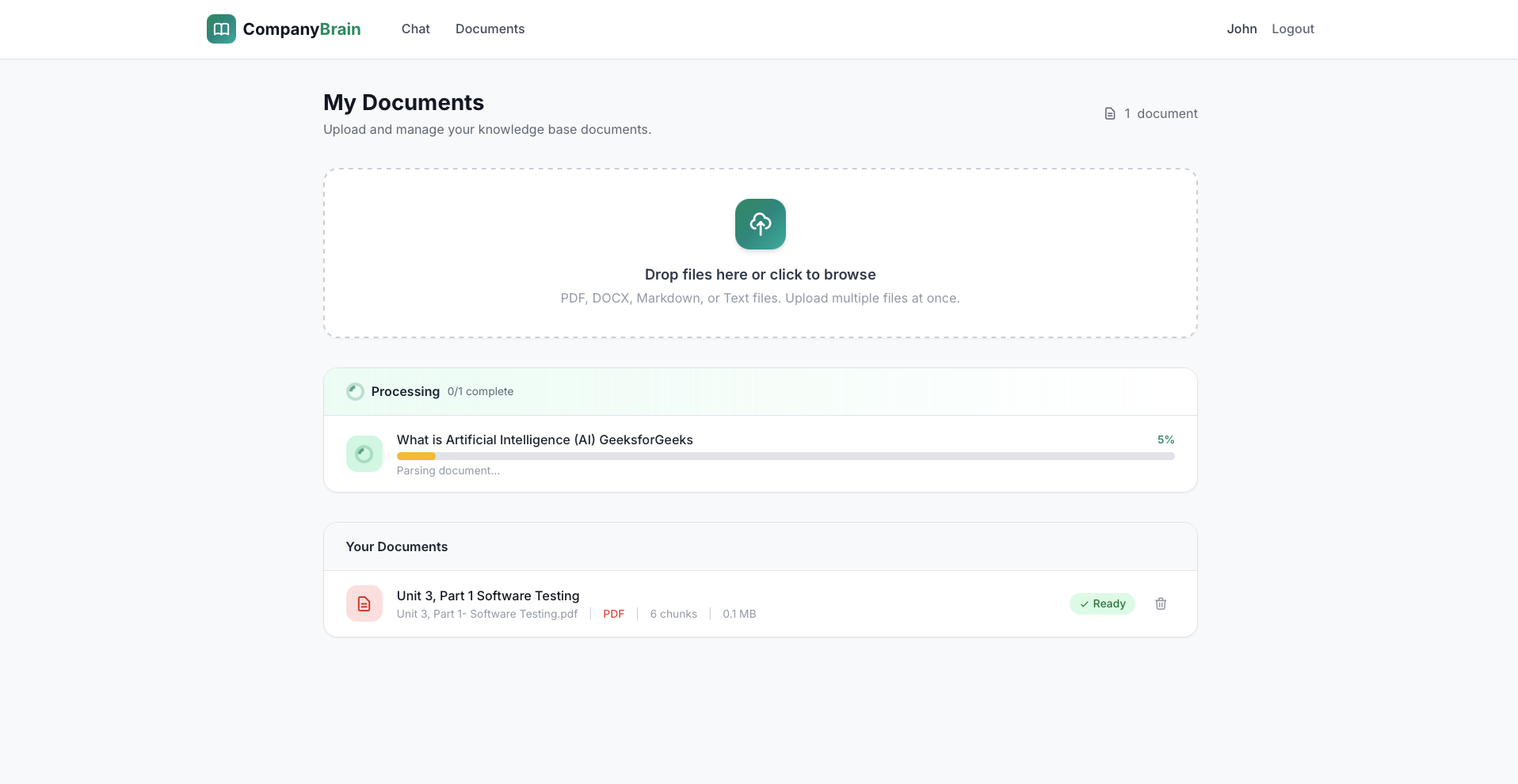
PDF, DOCX, Markdown, or plain text. Async background pipeline with live 0–100% progress.
LlamaParse for structured PDFs, smart 800-char overlapping chunks, OpenAI text-embedding-3-small vectors.
pgvector <=> operator returns top-5 most relevant chunks. User-scoped, status-filtered.
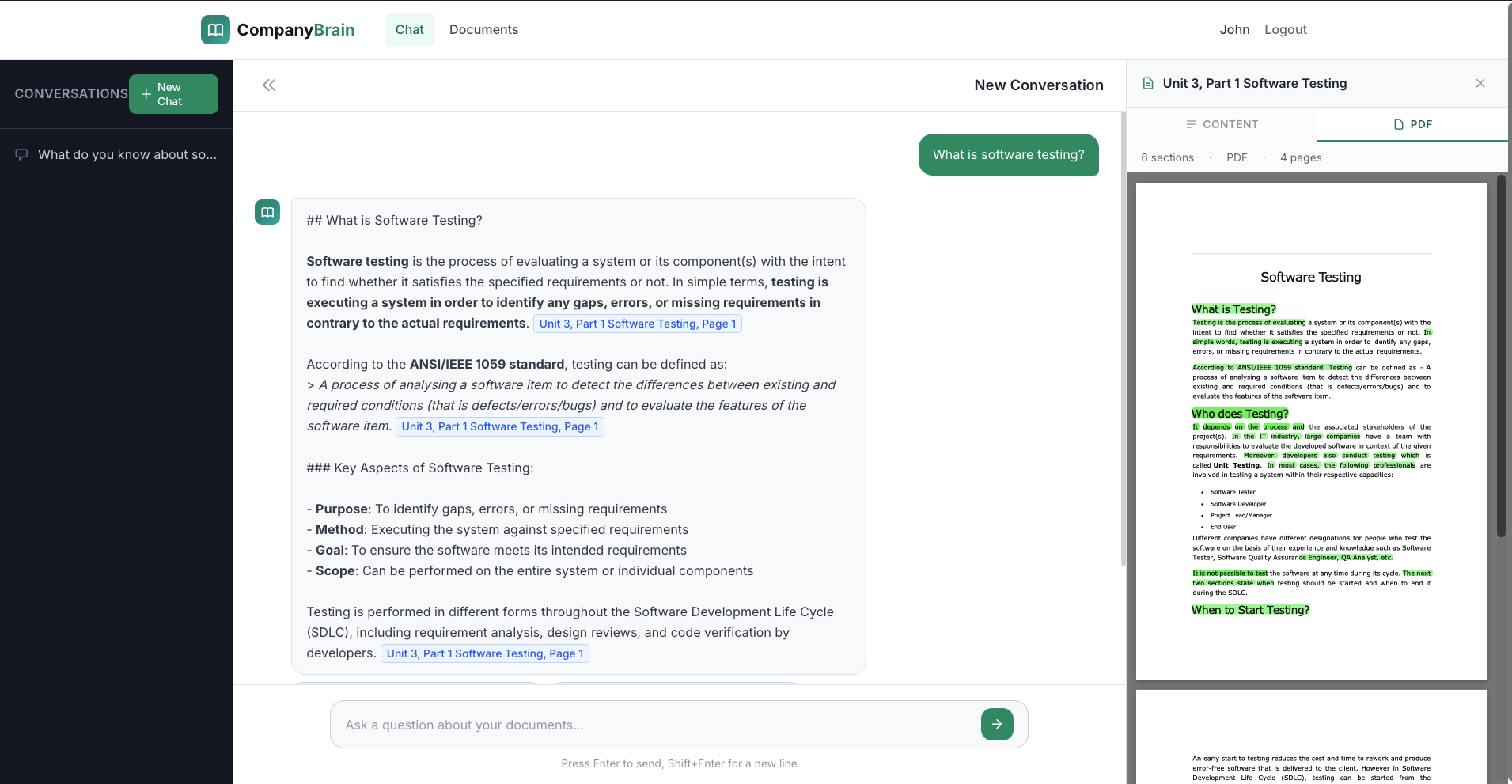
Context-grounded generation: answer + confidence + source references. Streamed token-by-token via SSE.
Last 10 messages in context. "Tell me more" and "How does that compare to…" just work.
# Full RAG loop — embed → retrieve → generate
async def handle_chat_stream(
query: str,
conversation_id: UUID,
user_id: UUID,
):
# 1. Embed the question
query_vec = await embedding_service.get_embedding(query)
# 2. Cosine similarity search (pgvector)
chunks = await retrieval_service.search_similar_chunks(
embedding=query_vec,
user_id=user_id,
top_k=5,
)
# 3. Build context from top-5 chunks
context = build_source_context(chunks)
history = await get_last_messages(
conversation_id, limit=10,
)
# 4. Stream answer from Claude
async for token in ai_service.stream_answer(
query=query,
context=context,
history=history,
):
yield f"data: {token}\n\n"
# 5. Persist message + sources
await store_message(
conversation_id, answer, sources, confidence,
)
Two pipelines — ingestion writes vectors; query reads them. Both fully async, streamed, and user-scoped.
PDF (LlamaParse structured), DOCX (heading detection), Markdown (header split), TXT. Async background processing with live 0–100% progress bar.
800-char max, 100-char overlap, sentence-boundary breaks. Section title + page number tracked per chunk for precise citations.
Vector storage lives inside PostgreSQL. No Pinecone or Weaviate. <=> cosine operator for top-k retrieval in a single query.
Token-by-token via SSE with cursor animation. Grounded to context only — "Answer ONLY from provided sources." JSON with confidence score.
Every answer cites the doc, page, and section. Click a citation → annotated PDF with green-highlighted source text via PyMuPDF.
Last 10 messages injected into context. Conversation persistence, list, load, delete. Follow-ups just work.
User/doc/chunk/message counts. Top-5 cited documents. Recent queries (trending topics). Document health dashboard.
Every document, chunk, conversation, and query filtered by user_id. OTP passwordless auth. Multi-tenant ready.
Local filesystem for dev, AWS S3 or DigitalOcean Spaces for production. Signed URLs for secure temporary access.
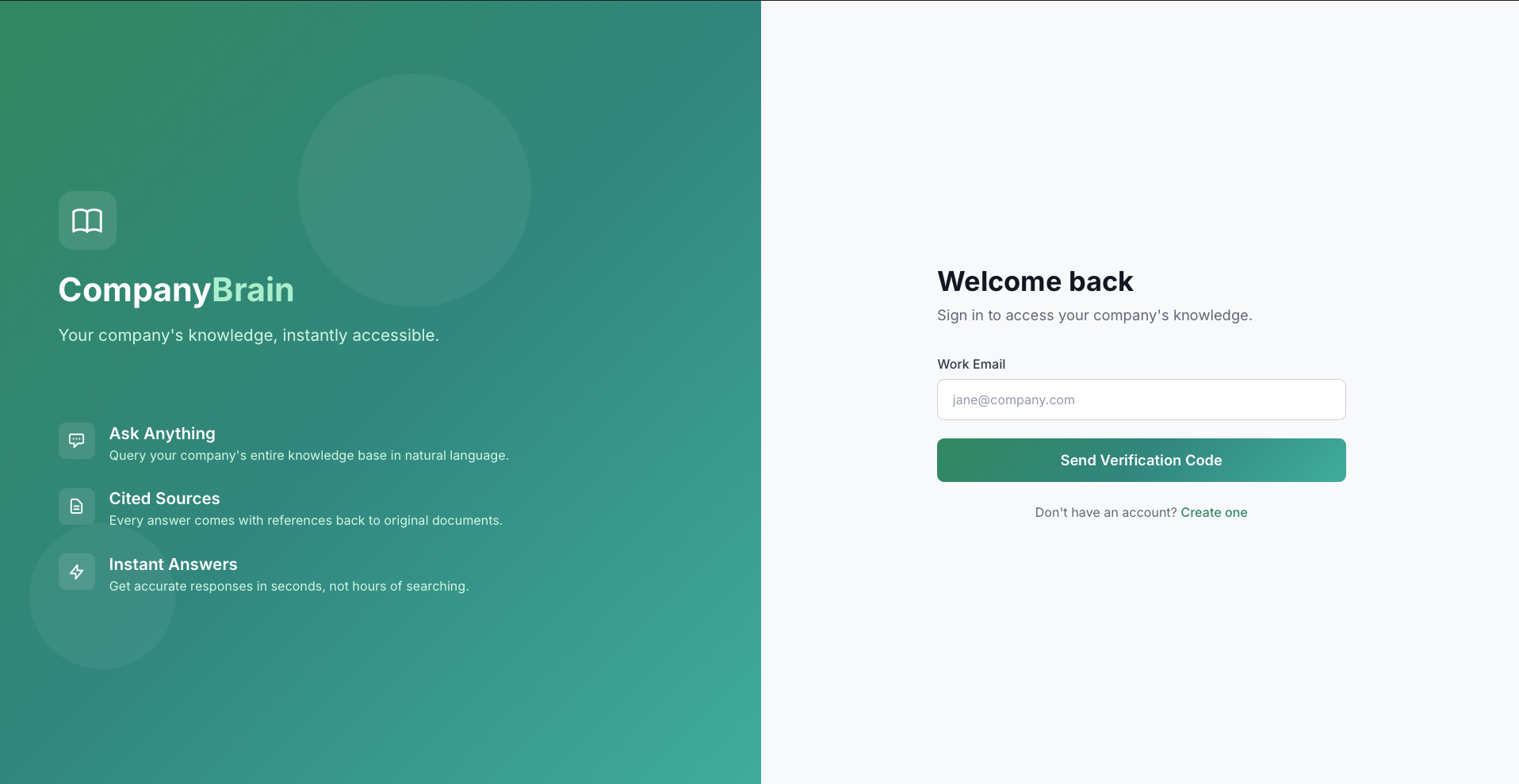
Enter email + name → 6-digit OTP → verified. No passwords, no friction.
Drag in the employee handbook, SOPs, runbooks. Live progress bar: parse → chunk → embed → ready.
"What's our PTO policy?" — embedded, searched across all chunks, top-5 retrieved by cosine similarity.
Claude generates, token-by-token. Sources show doc name, page, section, and similarity score.
Open annotated PDF — the exact text that Claude used is green-highlighted via PyMuPDF annotations.
"Can I carry over unused days?" — conversation memory keeps context. 10-message sliding window.
Every policy, every SOP, every runbook — indexed, searchable, citable. New hires self-serve from day one. Managers stop answering the same question twice.